Golden House Publications EGYPTOLOGY series
|
Marisol Solchaga
The Earthly Realm:
‘Offering-trays’ as material traces of the encounter between the living and the dead in Egypt, ca. 2200-1650 BC
(2024)
This volume examines the traces of ritual acts performed during less affluent burials, focusing on the use of 'offering-trays' as a case study. These pottery artefacts are dated to the First Intermediate Period and Middle Kingdom and typically feature pottery models on their surface. Those with attached architectural elements have traditionally been classified as 'soul-houses'.
This volume prefers to categorise them as 'offering-trays', considering the architectural element to be just one of the models represented on them.
This research aims to explore the function of these artefacts through the analysis of their physical features,
the models depicted on them, and their archaeological context. It aims to shed light on their significance as part of the material interplay between the living and the dead.
342 Pages (A4) many colour images; £100
|
|
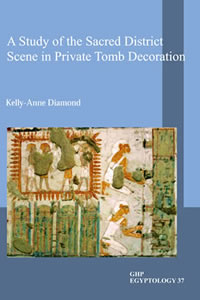
Kelly-Anne Diamond
A Study of the Sacred District Scene in Private Tomb Decoration (GHP Egyptology 37)
ISBN 978-1-906137-83-0, 167 plus vi pages, A4, paperback, many colour photos - London 2023
£60
A Study of the Sacred District Scene in Private Tomb Decoration compiles images from almost forty tombs, dating to the New Kingdom or later, and breaks down the different micro-scenes that can make up a Sacred District scene. These scenes are comprised of combinations of the seventeen different episodes, or micro-scenes, and are generally embedded within the funerary scenes in any given tomb. They typically appear in the passage of a T-shaped tomb and are the last scene before the deceased has reached the hereafter, thus suggesting that the Sacred District represents a liminal area the dead must traverse before the afterlife. The Sacred District reaches its peak in popularity during the reigns of Hatshepsut and Thutmose III of the eighteenth dynasty but can still be found in some late period tombs that exhibit archaizing trends. Examples are found on the west bank of Thebes and at Elkab and Hierakonpolis.
Contents pages |
|
Mohamed Osman Abdollah
Trade centers and Trade routes in Upper Egypt,
during the Old and Middle Kingdoms
(GHP Egyptology 36)
290 pages, richly illustrated, A4, paperback
GHP Egyptology 36, ISBN 9781906137793
£80
(2022)
(the volume is peer reviewed) |
|
|
|
Ripple in still water when there is no pebble tossed , Festschrift in Honour of Cary J. Martin (GHP Egyptology 34)
edited by
Adrienn Almásy-Martin, Michel Chauveau
Koen Donker van Heel, Kim Ryholt
about 308 pages, A4, paperback
UK £85
ISBN 978-1-906137-76-2
London 2022 This Festschrift in honour of Cary J. Martin presents twenty contributions of his friends and colleagues,
ranging from articles on Persian and Graeco-Roman Egypt to twenty-two (re-)editions of documentary and literary texts written in Egyptian
(Hieroglyphs, Hieratic and Demotic) and Greek. Many of these are published here for the first time.
Table of Contents |
|
Akhet Neheh -Studies in Honour of Willem Hovestreydt on Occasion of His 75th Birthday
Anke Weber, Martina Grünhagen, Lea Rees, Jan Moje (editors)
GHP Egyptology 33
168 pages, including 8 colour plates
November 2020, paper back
ISBN 978-1-906137-70-0
£60
(2020) |
|
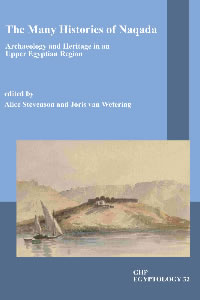
Alice Stevenson and Joris van Wetering (editors)
The Many Histories of Naqada
This edited volume presents a series of reviews, overviews and unpublished archives from several historic expeditions in the Naqada region of Upper Egypt. This includes nineteenth-century fieldwork led by Gaston Maspero, Jacques de Morgan and Flinders Petrie through to surveys conducted in the twentieth century and new initiatives in the region in the 2010s. It encompasses not just the better-known Predynastic finds, but also later Pharaonic era material as well as Coptic heritage. Together the volume argues that the Naqada region in worthy of renewed critical attention and is a more dynamic and complex landscape than has generally been acknowledged.
190 pages, paperback, A4
ISBN 9781906137694
June 2020
UK: £60 |
|
Helmut Satzinger
‘Is there not one among you who understands Egyptian?’
The Late Egyptian Language: Structure of its Grammar
GHP Egyptology 31
paperback, 170 pages, £35
ISBN 9781906137670
February 2020
UK: £35 |
|
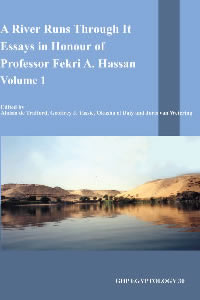
A River Runs Through It
Studies in Honour of Professor Fekri A. Hassan
Volume One
Edited by
Aloisia de Trafford, Geoffrey J. Tassie, Okasha el Daly and Joris van Wetering
GHP Egyptology 30
A4, paperback, 324 pages, with many images, including colour
UK: £60 - US: $90 |
|
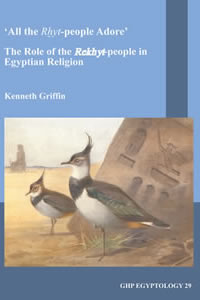
Kenneth Griffin All the Rxyt-people Adore: The Role of the Rekhyt-people in Egyptian Religion (GHP Egyptology 29)
ISBN 978-1906137625; 368 pages, A4, many b/w figures
£75 $150
Egyptian society is often said to have been divided into social classes, with the pat -people representing the 'elite'
and the rxyt -people being the 'commoners'. The aim of this study is to provide the first comprehensive analysis of the role of the rxyt -people in Egyptian religion by utilising both text and iconography. This includes exploring their identity, their participation in Egyptian rituals and temple festivals, and a detailed examination of the rxyt rebus. (the volume is peer reviewed) |
|
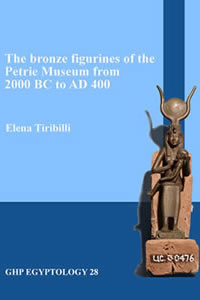
Elena Tiribilli
The bronze figurines of the Petrie Museum from 2000 BC to AD 400
366 pages, paperback; A4, over 500 b/w images
GHP Egyptology 28 £75 - $150
ISBN: 9781906137526 |
|
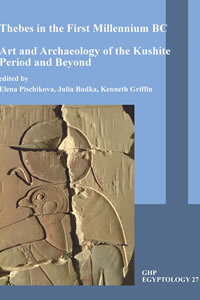
Elena Pischikova, Julia Budka, Kenneth Griffin (editors)
Thebes in the First Millennium BC: Art and Archaeology of the Kushite Period and Beyond
GHP Egyptology 27
This volume is a collection of articles, most of which are based on the talks given at the
conference of the same name in Luxor in 2016. It brings together a lot of current studies on royal and
elite monuments of the First Millennium BC , puts them into a wider context,
and fills some gaps in Egyptological scholarship.
£75 - 150$
(OUt of PRINT)
More information, click here |
|
Christian Langer (editor)
Perspectives of Egyptologies and on
Egyptologies in a Globalized World
GHP Egyptology 26
ISBN 9781906137557
paperback, A4, 220 pages
£45 - $ 80
for more information, click here
(the volume is peer reviewed) |
|
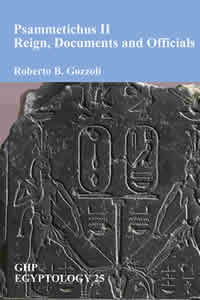
Psammetichus II, Reign, Documents and Officials
Roberto Gozzoli
GHP Egyptology 25
280 pages, including colour plates, paperback
ISBN 978-1906137410
UK price: £49 --- US price $ 99 |
|
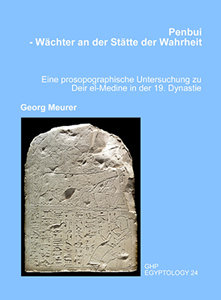
Penbui - Wachter an der Statte der Wahrheit: Eine Prosopographische Untersuchung zu Deir el-Medine in der 19. Dynastie
Georg Meurer GHP Egyptology 24
ISBN 9781906137465
A4, hardback, 261 pages, 24 colour plates
£ 75 - $150 |
|
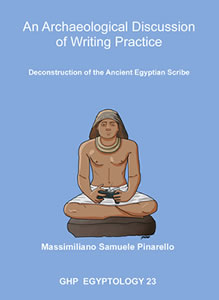
An Archaeological Discussion of Writing Practice - Deconstruction of the Ancient Egyptian Scribe
Massimiliano Samuele Pinarello
GHP Egyptology 23
A4, 196 pages, 8 colour plates
ISBN 9781906137458
£50 - $100
OUT-OF-PRINT |
|
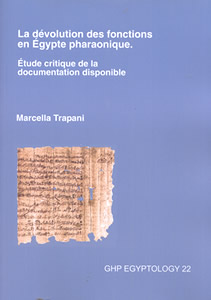
La dévolution des fonctions en Egypte pharaonique.
Etude critique de la documentation disponibile
Marcella Trapani
GHP Egyptology 22
334 pages, A4, paperback; London 2015
ISBN 978-1906137397
£35 - $70
OUT-OF-PRINT |
|
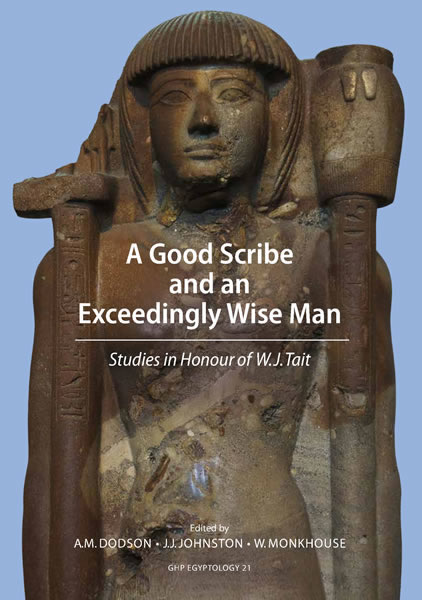
A Good Scribe and Exceedingly Wise Man
Studies in Honour of W.J. Tait
edited by A. Dodson, J. Johnston and W. Monkhouse
GHP Egyptology 21
ISBN 978-1-906137-33-5
348 pages; A4, paperback, London 2014
£60 - $120
for more information, click here |
|
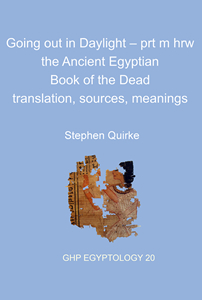
Stephen Quirke
Going out in Daylight – prt m hrw:
the Ancient Egyptian Book of the Dead - translation, sources, meanings
First full illustrated translation with Egyptian transliteration, aiming to present with their individual histories all the compositions on prt m hrw "Book of the Dead" papyri from the New Kingdom to Ptolemaic Period. The volume gives at least one version of every written composition, together with one or more images for the essential pictorial component of all writings for which illustrations are known. Writings at the margins or outside the prt m hrw corpus, including all ascribed "Book of the Dead" numbers in Egyptological publications, are included in the final section. The translations are supported by a thematic and historical introduction and closing glossary.
A4, 641 pages, paperback; ISBN 9781906137311; 2013
£85
|
|
Wolfram Grajetzki
Danijela Stefanovic
Dossiers of Ancient Egyptians –the Middle Kingdom and Second Intermediate Period - addition to Franke's ‘Personendaten'
GHP Egyptology 19
£25 - $50 |
|
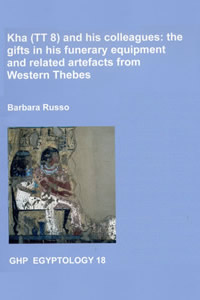
Barbara Russo
Kha (TT 8) and his colleagues: the gifts in his funerary equipment and related artefacts from western Thebes, GHP Egyptoloy 18
The author looks at several objects found in the undisturbed tomb of the 18th Dynasty architect Kha. These objects name other officials and were evidently gifts for Kha. They provide evidence of a social network around the architect and evidence for gift giving at the highest social level. A4 104 pages, 8 colour plates
ISBN 978-1906137-28-1
£35 - $70 |
|
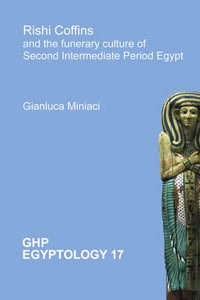
Gianluca Miniaci
Rishi Coffins and the Funerary Culture of Second Intermediate Period Egypt
GHP Egyptology 17
A4, 318 (+ XVIII) pages and 8 colour plates
ISBN 978-1-906137-24-3
£50 - $ 100
This volume is the first in-depth study of Egyptian Second Intermediate Period rishi coffins.
It includes a catalogue of all published and many unpublished rishi coffins and provides an evaluation of the funerary culture
of the period with a typology of rishi coffins. Most coffins are presented with photographic pictures. This includes all examples stored in the Egyptian Museum of Cairo and unpublished material from Winlock's excavations in Thebes.
(OUt of PRINT) Online - click here
|
|
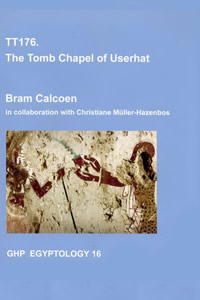
Bram Calcoen
in collaboration with Christiane Müller-Hazenbos
TT176. The Tomb Chapel of Userhat; GHP EGYPTOLOLOY 16
This is the publication of the Theban tomb chapel of the 'servant of Amun' Userhat.
The chapel belongs to the smallest in the Theban necropolis but is decorated with paintings
of highest quality, many of them today badly damaged. The volume includes
old archive photographs and drawings by S. Schott and Davies. Together with new
drawings and photographs they provide a full picture of a small Theban tomb chapel
datable to the reign of Thutmosis IV.
ISBN 978-1906137274
34 pages + 23 b/w plates; 4 colour plates, paperback, A4
£35 - $70 |
|
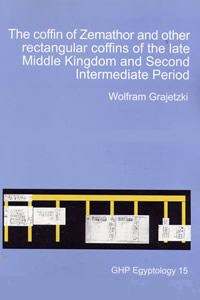
Wolfram Grajetzki
The coffin of Zemathor and other rectangular coffins of the late Middle Kingdom and Second Intermediate Period
GHP Egyptology 15
This is the publication of several coffin fragments, most of them found as drawings in notebooks of old excavations. The book includes a list of published rectangular coffins of the Second Intermediate Period and a discussion of the main text programmes and related religious beliefs.
A4, Paperback, 120 pages, 8 plates
UK £30 - US $60 |
|
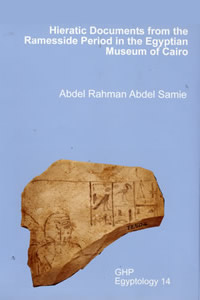
Abdel Rahman Abdel Samie
Hieratic Documents from the Ramesside Period in the Egyptian Museum of Cairo
GHP Egyptology 14
This is a publication of 17 ostraca and 2 jar labels from the Valley of the Kings. They all attribute to Th. Davis and Carter/ Carnarvon's excavations. The corpus of this research has revealed that workmen likely exploited the Valley of the Kings as a
temporary settlement. This hypothesis is corroborated by the recent
excavations that discovered a wide spread of huts throughout the main valley along with its lateral ones. The increase in number of workmen that took place sometime during the ruling years of Ramses IV would have provided the impetus to build these huts as a sort of temporary inhabiting extension to the neighbouring settlement of Deir el Medina.
ISBN: 978-1-906137-21-2
A4, 120 pages, 16 plates
£30 - $ 60 |
|
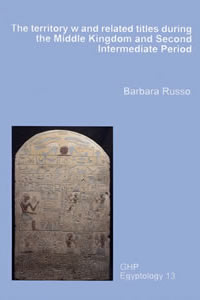
Barbara Russo
The territory w and related titles during
the Middle Kingdom and Second Intermediate Period
This monograph is an in-depth study on the administrative title 'district overseer' (imy-r w) and the term 'district' or 'rural district' (w) in the Egyptian Middle Kingdom (about 2050 to 1650 BC). The sources demonstrate that the territory 'w' was created for some particular administrative needs at the end of the First Intermediate Period. From the historical point of view the management of the 'w' fits the organisation of the society created in this period. The title is still attested in the later Middle Kingdom but lost it importance. The book contains detailed discussions on the title holders and the attestations of 'w'. 96p, 8 plts.
ISBN 978-1906137182
£28 - $ 55 |
|
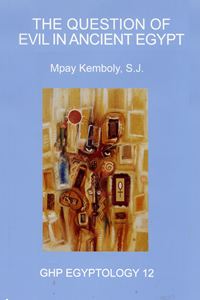
Mpay Kemboly, S.J.
The Question of Evil in Ancient Egypt
The book examines relevant sources from the Old Kingdom Pyramid Texts (c. 24th century B.C.E.) to the Graeco-Roman Period inscriptions (2nd century C.E.) in order to understand the way the ancient Egyptians tackled the question of the origin of evil in the world. It also investigates whether the world was perfect or imperfect since its beginning. Scholars addressing these questions are generally of two categories: those advocating the pre-existent character of evil and asserting therefore that the world was not perfect since its creation, and those who plead for the contingent nature of evil and thus imply that the world was created perfect at the beginning but was marred afterwards by various protagonists other than the creator. 416 pages
ISBN 978-1906137151
OUT OF PRINT |
|
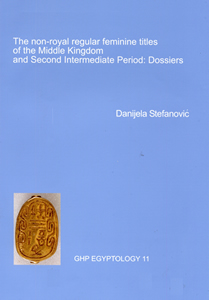
Danijela Stefanović
The Non-Royal Regular Feminine Titles of the Middle Kingdom and Second Intermediate Period: Dossiers, GHP Egyptology 11 This book lists the dossiers of the holders of the Middle Kingdom and Second Intermediate period regular non-royal feminine titles: iryt-pat (rpatt), anx(t) n(t) niwt, anxt nt nswt tpt, aHayt, aqyt, wbAyt (wbAt), bAkt nt HqA, mnat, Hsyt (Hst), xtt-pr, and Xkrt-nswt. The dossiers, with a description and discussion for each title, contain lists of the sources in which the title holder is attested, as well as data concerning the family members, and a selected bibliography.
153 page, A5 - ISBN-13: 978-1-906137-12-0
£20 - $40 |
|
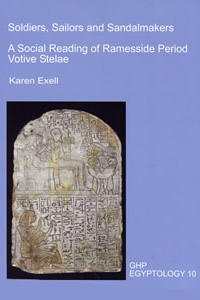
Karen Exell
Soldiers, Sailors and Sandalmakers: A Social Reading of Ramesside Period Votive Stelae , GHP Egyptology 10,
The book sets out to explore the meaning of votive stelae to the individuals who dedicated them, and the nature of the events that they commemorate, during the Egyptian Ramesside Period (1295-1069 BC). All stelae can be described as commemorative, utilised to record a variety of types of information, from royal decrees, participation in expeditions and votive activity, to funerary texts securing offerings for the deceased. The Egyptian word for 'stela' is 'wedj,' which also has the meaning 'proclamation, declaration, order', and the stelae allow the information proclaimed to be commemorated eternally. The stelae in this discussion commemorate votive activity by private individuals.
213p + 16 black and white plate ISBN: 9781906137106 UK £30 - US £ 60 |
|
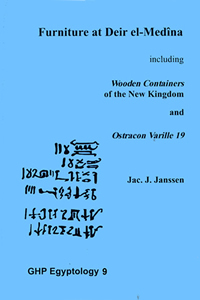
Jac. J. Janssen
Furniture at Deir el-Medîna, including Wooden Containers of the New Kingdom
and Ostracon Varille 19; GHP Egyptology 9
ISBN 978-1-906137-07-6
The aim of this book is to find the link between words and household objects. Using ostraca and papyri from the workmen’s village at Deir el-Medîna, the author discusses both the kind and relative frequency of furniture and wooden receptacles used in a typical New Kingdom home. Forty words referring to normal household objects also feature in the remarkable and previously unpublished Ostracon Varille 19. These are compared with other occurrences in order to assess how common each article was in the life of the community.
108 pages
£ 16.99 |
|
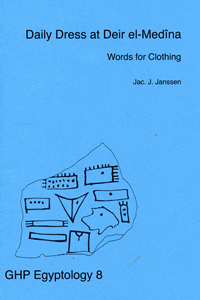
Jac J. Janssen Daily Dress at Deir el-Medina, Words for Clothing, GHP Egyptology 8
What clothes did ordinary people wear during the New Kingdom ? Evidence for this occurs mainly in the papyri and ostraca from Deir el-Medîna, the village of the workmen who built the royal tombs in the Valley of the Kings . It is, however, still a problem what exactly each of the words for garments means. This book attempts to provide some solutions.
118 pages, A5
ISBN 978-1-906137-05-2
UK £15 - US $ 32 |
|
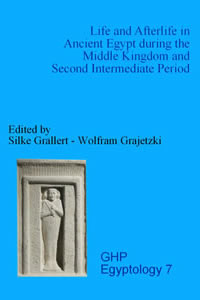
Silke Grallert - Wolfram Grajetzki (editors)
Life and Afterlife in Ancient Egypt during
the Middle Kingdom and Second Intermediate Period
GHP Egyptology 7
paperback 160 pages + 8 plates, A4
ISBN 978-1906137014
£25 - $ 55 |
|
Contributions from a range of specialists on Middle Kingdom and Second Intermediate Period religion, administration and culture.
Backes, Burkhard
Principles of Decoration on Middle Kingdom Stelae
Grajetzki, Wolfram
Multiple Burials in Ancient Egypt to the End of the Middle Kingdom
Grallert, Silke
The Mitre Inscriptions on Coffins of the Middle Kingdom:
A New Set of Texts for Rectangular Coffins?
Horváth, Zoltán
Remarks on the Temple of Heqet and a Sarcastic Letter from el-Lahun
Lange, Eva
Khenemet Nefer Hedjet Weret in the Great Temple of Tell Basta ( Bubastis)
Miniaci, Gianluca
Some Remarks on the Development of rishi Coffins
Quirke, Stephen
‘Book of the Dead Chapter 178’:
A Late Middle Kingdom Compilation or Excerpts?
Stefanović, Danijela
aHAwtyw of the Middle Kingdom
Whelan, Paul
An Unfinished Late Middle Kingdom Stela from Abydos |
|
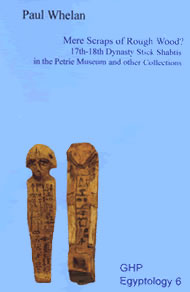
Paul Whelan
Mere Scraps of Rough Wood?
17th – 18th Dynasty Stick Shabtis in the Petrie Museum and Other Collections, GHP Egyptology 6
This monograph represents the first comprehensive investigation of the characteristically crude wooden ‘stick’ shabtis of the late 17 th and early 18 th Dynasties. Developed from a case study of examples in the Petrie Museum of Egyptian Archaeology and building upon scholarship that has until now focussed almost exclusively on the importance of their inscriptions, the work offers new perspectives on stick shabtis and their role in the cultic milieu during a transitional period in ancient Egyptian history. The broad based analysis draws upon excavation reports, archival material and a comparative examination of the physical characteristics of stick shabtis in the Petrie Museum and from other collections, in order to challenge the generally held view that besides their inscriptions these simple figures are little more than, to quote Flinders Petrie, “mere scraps of rough wood”. The book is profusely illustrated throughout and incorporates a detailed catalogue of stick shabtis in the Petrie Museum as well as a number of previously unpublished examples from public and private collections.
Paperback, viii + 151 pages, 21 x 92.5 cm
ISBN 978-1-906137-00-7
£25 - $55 |
|
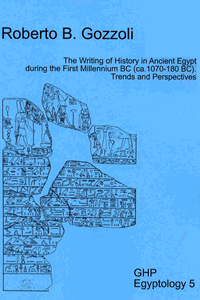
Roberto Gozzoli
The Writing of History in Ancient Egypt during the First Millennium BC (ca.1070-180 BC).
Trends and Perspectives, GHP Egyptology 5
The relevance of royal inscriptions, Herodotus and Manetho in order to reconstruct the chronology and
history of ancient Egypt has been fundamental in scholarly research since Champollion’s times.
Those sources however, together with other historical and pseudo-historical material such
as the Bentresh and Famine stelae are here analysed as historical documents per se, completely
disregarding their value for the histoire événementielle. Genre and format of royal inscriptions
become important in order to establish the power of the tradition, while all the historical
sources mentioned above embody hopes, fears, as well as social and cultural conflicts existing
in Egyptian society at the times they were written.
Paperback, XII + 398 pages, 17.5 x 24.8 cm
ISBN 09550256-3-X
£ 29.99 - $55
OUT OF PRINT |
|
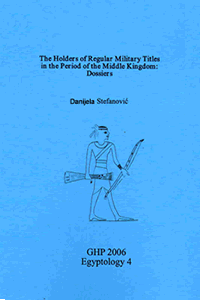
Danijela Stefanović
The Holders of the Regular Military Titles in the Period of the Middle Kingdom: Dossiers
GHP Egyptology 4
London 2006
Paperback, 254 pages, A5
ISBN 0-9550256-6-4
This book will list the dossiers of the holders of the Middle Kingdom regular military titles: chief overseer of the army, overseer of the army, secretary to the army, commander of the crew of the ruler, commander-in-chief of the city regiment, commander of the city regiment, soldier of the crew of the ruler, solder of the city regiment, warrior, controller of guards, guard of the ruler, guard of the first battalion, guard of the palace approach, guard, bowmen, overseer of soldiers. The dossiers, which are presented in alphabetical order, also contain lists of the sources in which the title holder is attested, as well as data concerning the family members, and a selected bibliography.
OUT of PRINT |
|
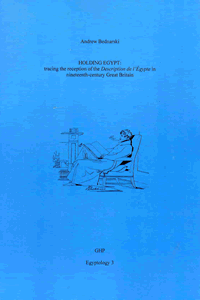
Andrew Bednarski
Holding Egypt: tracing the Reception of the
Description de l'Egypte in Nineteenth-Century Britain
GHP Egyptology 3
London 2005
Paperback, vi + 106 pages, 21 x 29.7 cm (A4)
ISBN 0-9550256-0-5
Any person with an interest in the history of Egyptology quickly learns of the monumental Description de l'Egypte, a result of research undertaken by French scholars during Napoleon's invasion of Egypt in 1798. The starting point for this study is the long-standing belief, particularly visible in English literature, that this nineteenth-century French corpus was the first point in the development of Egyptology. Yet despite this oft-repeated belief, the issues of where exactly the work went, or what people made of it have yet to be explored. This book attempts to test the broad notion that the Description was the seminal point in the development of Egyptology by exploring its reception in Great Britain, in the early nineteenth century.
£ 22 £ - $50 |
|
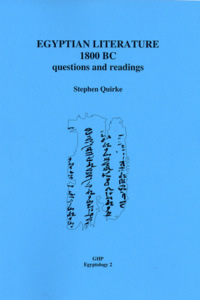
Stephen Quirke
Egyptian Literature 1800 BC
questions and readings
GHP Egyptology 2
London 2004
Paperback, 226 pages, 21 x 29.7 cm (A4)
ISBN 0-9547218-6-1
Defining the literary as the content of literary books, as a distinctive material product, the author provides transliteration and translation into English for every surviving literary composition from the Middle Kingdom. Alongside famous intact masterpieces such as the Tale of Sanehat (Sinuhe), all literary fragments are also included. The series of translations is preceded by a short general discussion of four key aspects of literature: survival of books (with a list of the ten surviving groups of books from ancient Egypt); definitions of literature; authorship, the question of how literary works were composed; and reception, the question of how they were read.
£30
OUT of PRINT
|
|
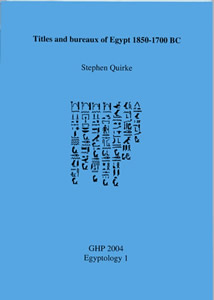
Stephen Quirke
Titles and bureaux of Egypt 1850-1700 BC
Egyptology 1
London 2004
Paperback, 153 pages, 14.8 x 21 cm
ISBN 0-9547218-0-2
A thematic dictionary of the most important titles of the Late Middle Kingdom;
with a short description and short bibliography for each title.
£25 |
for
orders - only prepaying is accepted, but we do not accept credit cards- please contact us - we do not charge packing
or shipping within the UK:
» Golden House
Publications
Publishing with Golden House
Publications
Golden House Publications
PO Box 51920
London SW9 0YW
United Kingdom
|